 blog
blog
Best Promotional Items for Small Business Marketing
Table of Contents
- Why Promotional Items Still Work for Small Business Marketing
- Comparison Table: Top Promotional Items by Cost and Impact
- Top Promotional Item Categories for Small Business Marketing
- Low Cost Promotional Items for Small Business That Deliver High Recall
- How to Choose Promotional Products for Brand Awareness
- Best Branded Office Supplies for Clients and Employees
- Measuring ROI and Planning Distribution Logistics
- Frequently Asked Questions
Last Updated: September 18, 2026
Why Promotional Items Still Work for Small Business Marketing
Promotional items remain one of the most reliable tools in a small business marketing budget because they put a physical, branded object into a customer's daily routine. At BicClic.com, we've spent over 14 years helping companies turn pens, drinkware, and office supplies into repeat brand impressions. The best promotional items for small business marketing are the ones people actually use, not the ones that look impressive in a catalog.
Comparison Table: Top Promotional Items by Cost and Impact
This table ranks common promotional items by cost tier, typical usage frequency, and the goal each serves best. Use it to match an item to a specific objective before you order in bulk.
| Item | Cost Tier | Usage Frequency | Best For |
|---|---|---|---|
| Custom imprinted pens | Low | Daily | Broad brand awareness |
| Sticky notes and notepads | Low | Daily | Office and client appreciation |
| Branded drinkware | Mid | Daily | Customer retention, employee gifts |
| Tote bags | Mid | Weekly | Trade show giveaways |
| Branded apparel | Higher | Weekly | Team identity, event marketing |
| Premium gift sets | Higher | Occasional | Client appreciation, corporate gifting |
Top Promotional Item Categories for Small Business Marketing
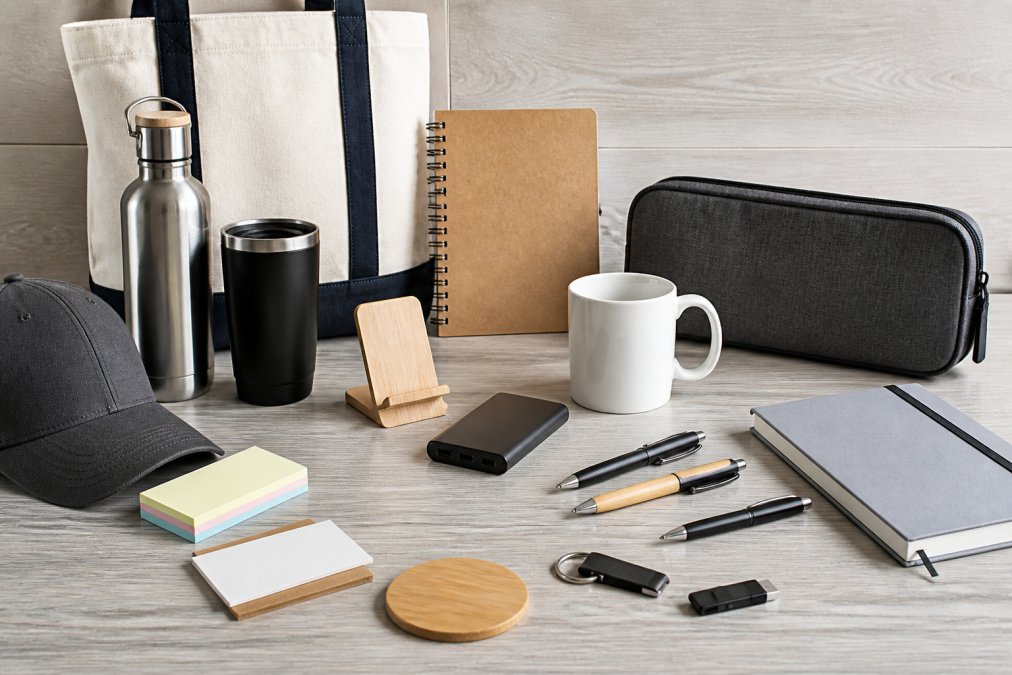
Promotional product categories sort into a few clear groups, and the strongest performers share one trait: they get used without the recipient thinking about it. Drinkware, office essentials, and trade show giveaways cover most small business needs.

Drinkware and Office Essentials
Drinkware and office essentials are the workhorses of any promotional strategy. A branded tumbler or mug sits on a desk and gets handled multiple times a day, which builds brand recall with almost no extra effort. Custom imprinted pens work the same way. They travel between desks, get borrowed, and often end up in a different office entirely.
Trade Show Essentials and Giveaways
Trade show essentials serve a different job: they pull people toward your booth. Utility-focused items work best here. Attendees ignore cheap trinkets, but they stop for something they can actually use during the event, like a tote bag for collected materials or a pen for filling out forms.
Low Cost Promotional Items for Small Business That Deliver High Recall
Low cost promotional items for small business work when they land in daily use. Pens and sticky notes cost little per unit and get handled constantly, which is why they remain the default choice for tight marketing budgets.
- Custom imprinted pens: lowest cost per impression, highest daily use
- Sticky notes and memo pads: sit on desks, get seen by coworkers
- Fridge magnets and calendars: long lifespan, high household visibility
- Branded hand sanitizer or lip balm: practical, kept in bags and pockets
How to Choose Promotional Products for Brand Awareness
How to choose promotional products for brand awareness comes down to matching the item to the audience, the setting, and the goal. Most guides stop there. The real differentiator is choosing by business type, because a giveaway that works for a real estate agent often fails for a software startup.
Match the Item to Your Business Type
- Real estate and insurance: Clients interact with you at high-stakes, in-person moments. Branded closing gifts like a quality pen, a leather portfolio, or a magnetic calendar that stays on the fridge keep you visible between transactions. Durability matters more than novelty here.
- Restaurants and retail: Volume and repeat visits drive the math. Branded cups, koozies, and reusable tote bags get used weekly and travel through the community. Prioritize items that leave your location and get seen by new people.
- Tech startups and B2B services: Your audience is desk-bound and skeptical of swag. A branded notebook, a quality pen, or a desk accessory like a phone stand earns a spot on the desk. Cheap plastic items read as a mismatch with a premium product.
- Health, wellness, and fitness: Items tied to the daily routine perform best. Branded water bottles, gym towels, and resistance bands get used during the activity your brand is associated with, which reinforces the connection every session.
- Professional services (legal, accounting, consulting): Client-facing items should feel considered, not promotional. A premium pen handed across a desk reads differently than a conference giveaway. Spend more per unit and give to fewer people.
Weigh Durability and Customization Method
A logo that fades after a few washes hurts brand recall more than it helps. Match the decoration method to the material:
- Screen printing works well on flat fabric and plastic but can crack on stretchy or curved surfaces.
- Embroidery holds up on apparel and bags but adds cost and limits fine detail.
- Laser engraving suits metal and wood drinkware and produces a permanent mark that won't wash off.
- Pad printing handles small, curved items like pens and stress relievers.
Be Honest About the Goal
If you want broad awareness, prioritize high-use, low-cost items and distribute widely. If you want customer loyalty or client appreciation, spend more per unit on something premium and give it to a smaller list. Trying to do both with one item usually produces something too expensive to give broadly and too cheap to impress.
Best Branded Office Supplies for Clients and Employees
Best branded office supplies for clients do double duty: they serve a practical purpose and keep your brand on the recipient's desk. For clients, branded notepads, folders, and quality pens signal that you pay attention to detail. For employees, the same items reinforce brand identity from the first day.
Measuring ROI and Planning Distribution Logistics
Measuring ROI on promotional products starts with tracking distribution and pairing each item with a response mechanism. Without that, you're guessing. With it, you can compare cost-per-impression across items and shift budget toward what works. Most promotional product articles list items and stop. This section covers the two things they skip: how to attribute results, and how to actually get the items into the right hands.
A Simple ROI Framework
- Set a unit cost and quantity for each item before ordering.
- Track where each item goes (event, client, employee, prospect).
- Attach a measurable action to the item, such as a QR code, a dedicated landing page, or a unique promo code.
- Count responses over a set window, typically 30 to 90 days.
- Calculate cost-per-response and compare against your other channels.
How to Attribute Responses
Attribution is where most small businesses give up, so keep it simple. Use one tracking method per campaign and don't mix them:
- Unique promo codes work best for direct mail and client gifts, where the recipient acts alone. Each code ties a redemption back to a specific item and audience.
- Dedicated landing pages work for trade shows and events. A short URL printed on the item sends traffic to a page that only that audience would know about.
- QR codes work for high-traffic, low-friction moments like a booth or a receipt insert. Point them to a page with a single clear action, not a homepage.
What a Reasonable Benchmark Looks Like
There is no universal conversion rate for promotional products because results depend on the item, the audience, and the offer. What you can do is compare items against each other within your own campaigns. If a branded tumbler generates three times the responses of a branded tote at a similar unit cost, shift budget toward the tumbler next quarter. The goal is relative improvement, not an industry benchmark.
Distribution Logistics by Channel
How you distribute matters as much as what you distribute. Each channel has different costs and different failure modes:
- Trade shows: Shipments must arrive before setup, not during it. Plan your delivery timeline backward from the event date and confirm lead times with your supplier in writing. Keep premium items behind the table and hand them out only after a real conversation.
- Direct mail: Pair the item with a printed offer and a unique code. Bulk mail rates and packaging costs add up, so test a small batch before scaling.
- Client gifts: Hand-deliver or ship individually. The personal touch is the point, so don't batch these into a generic fulfillment process.
- Employee onboarding: Build the item into the first-day kit so it arrives with the rest of the onboarding materials. This reinforces brand identity from the inside out.
Frequently Asked Questions
What are the most effective promotional items for small businesses?
High-use items like branded pens, drinkware, and office supplies deliver the strongest results because people see and touch them daily. Utility-focused giveaways such as genuine Bic pens, notebooks, and travel mugs generate repeated brand impressions at a low cost-per-impression. Items that solve a daily problem stay in circulation longer, which builds brand recall and keeps your name in front of customers without additional spend.
How do you choose the right promotional products for your brand?
Start with your goal: brand awareness, lead generation, or customer retention. Match the item to your audience and setting. For trade shows, choose portable giveaways that fit in a bag. For client appreciation, choose higher-quality desk items. Set a per-unit budget, order samples to check durability, and confirm logo placement before bulk ordering. The right choice balances usefulness, cost, and how well the item reflects your brand identity.
How can small businesses maximize ROI on branded merchandise?
Focus on items people use often. A pen kept on a desk generates hundreds of impressions over its lifetime, driving a very low cost-per-impression compared with digital ads. Track results by using unique QR codes or landing pages tied to each giveaway. Limit distribution to qualified audiences, and reorder proven winners instead of testing new items every campaign. This approach turns a small marketing budget into consistent brand visibility.
What is the best way to distribute promotional items to customers?
Hand items directly to people who match your target audience. At trade shows, place giveaways at the booth so attendees must engage with your team. For client appreciation, include branded office supplies with invoices or thank-you notes. For lead generation, offer a useful item in exchange for contact information. Avoid leaving piles of items unattended, since unclaimed merchandise rarely reaches the right people and wastes your marketing budget.