 Listicle
Which Custom Branded Office Supplies Suit a Startup?
Last Updated: November 7, 2026
Quick Summary
For a startup, the best custom office supplies are a branded pen, a notebook or notepad, and one practical accessory such as a charging pad or desk organizer. Start with a modest first order covering two or three categories, then scale the items that actually get used. Pens are the most common option because they are inexpensive and easy to carry.
- Start with two or three categories of custom office supplies and a modest quantity.
- Choose one or two pen styles and order them consistently across onboarding and events.
- Request a proof before approving a large order to check the imprint is legible.
- Compare minimum order quantities, turnaround times and total landed cost between suppliers.
- Track which items run out first and use that usage data to plan your reorder.
Table of Contents
- Why Startups Should Brand Office Supplies First
- Custom Pens and Writing Instruments That Get Used
- Branded Notebooks, Notepads and Desk Organizers
- Tech Accessories and Office Essentials With a Logo
- Choosing Suppliers: Wholesale Versus Online Ordering
- Setting a Startup Budget, Order Size and Artwork Plan
- Ordering Your First Branded Kit From BicClic.com
- Frequently Asked Questions
Why Startups Should Brand Office Supplies First
Branded office supplies for startups do more than fill a desk drawer, and well-chosen custom office supplies can reach far more people than a single campaign. They put your company name in front of employees, clients and visitors every day, often at a lower cost than paid advertising. For a young company with a small marketing budget, that repeat exposure matters.
BicClic.com has served businesses across North America for over 14 years, producing custom imprinted pens and promotional office items. The first branded items a startup orders can set the tone for how its team and customers see the brand. Choose them with the same care you would give a logo.
The main advantage is consistency. A pen on a client's desk, a notebook in a hiring manager's bag or a charging pad in a shared office reinforces your brand without a new campaign. Startups can start small, learn what gets used, and expand from there.
Many founders make one common mistake: they order a large batch of a single item before testing whether anyone uses it. Start with two or three categories of custom office supplies and a modest quantity. That approach keeps spending controlled while you measure what actually stays on desks.
Custom Pens and Writing Instruments That Get Used
Pens remain the most common of all custom office supplies, and for good reason. They are inexpensive, practical and easy to carry. The challenge is making sure your pen gets used rather than tossed in a drawer.
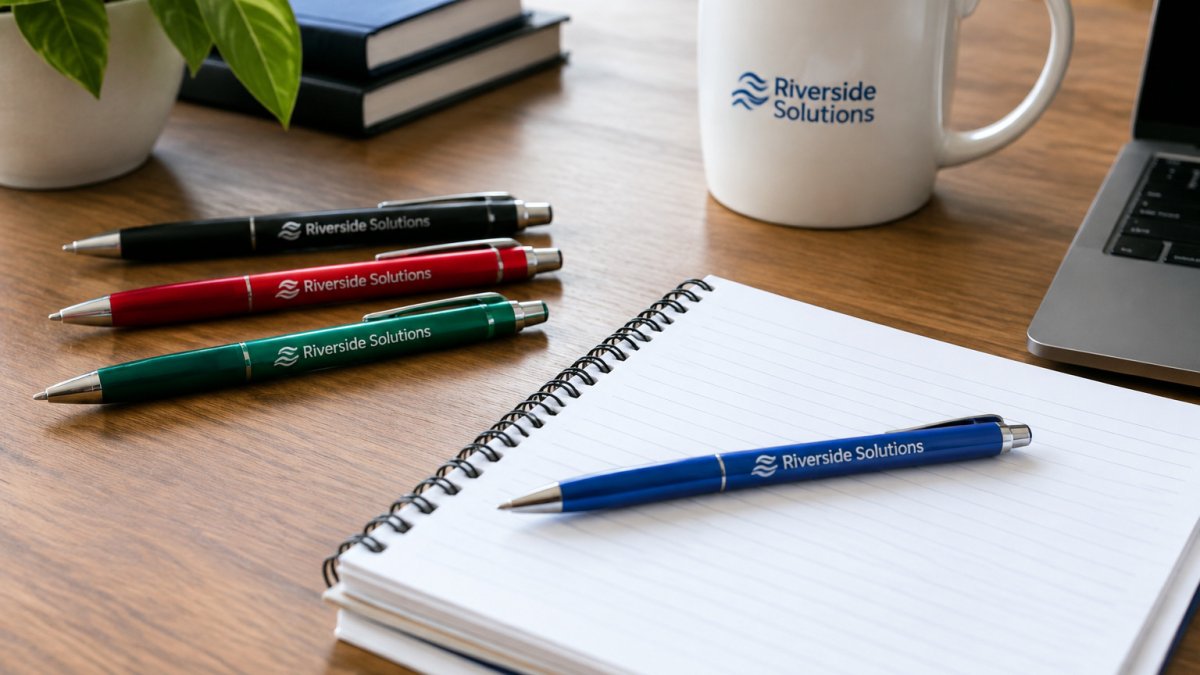
Choose a writing instrument that feels good in the hand. A pen that writes smoothly and has a comfortable grip is far more likely to stay in circulation. Logo placement also matters: a clean, legible imprint on the barrel tends to hold up better than a crowded design.
Our recommendation for startups is to pick one or two pen styles and order them consistently. Using the same pen across onboarding kits, client meetings and trade shows builds familiarity.
Watch out: a pen with a faint or hard-to-read imprint can look cheap, even when the pen itself is good quality. Request a proof before approving a large order.
Branded Notebooks, Notepads and Desk Organizers
Notebooks and notepads give your brand a longer presence on a desk than most small items. A logo on the cover is visible during every meeting where the notebook is open. For client appreciation, a well-made notebook signals care.
Desk organizers, sticky notes and calendars work well as complements to other custom office supplies. Sticky notes are inexpensive and get used quickly, which means frequent reminders of your brand. Desk organizers last longer and suit employees who spend most of their day at a workstation.
Consider the audience before choosing. Internal items like notebooks for new hires suit onboarding kits. Client-facing pieces, such as a premium notebook with a debossed logo, suit appreciation gifts. Match the quality to the relationship.
Tech Accessories and Office Essentials With a Logo
Technology accessories, such as power banks and USB chargers, have broader appeal than traditional stationery. Employees and clients use them daily, and a branded power bank can stay in use for months.
Office essentials like staplers, magnets and paper clips round out a branded kit. These items are less exciting but useful, and they reinforce your brand in shared spaces such as a kitchen or a conference room.
Keep the mix balanced. A kit with a pen, a notebook and one tech item covers most needs without overspending. Evaluate each supplier option on quality and total cost, not only on the item list.
Choosing Suppliers: Wholesale Versus Online Ordering
Startups rarely need the same supplier model as a 500-person company when sourcing custom office supplies. The right choice depends on order size, how many products you are testing, and how quickly you need reorders.
Wholesale and online ordering models each suit different order sizes and reorder needs. Smaller batches and a quick reorder process can suit a team that wants to test two or three items before committing to a larger program.
For a startup, the practical approach is to start with a supplier that allows low minimums and clear per-item pricing, then move to wholesale pricing once you know which items your team and clients actually use.
When comparing options, check these points:
- Minimum order quantity: Confirm the lowest quantity per item, not just per order. Some suppliers require 50 or 100 units per style.
- Artwork and proofing: Ask about accepted file formats, proof turnaround, and whether a physical sample is available before a large run.
- Turnaround time: Get a delivery date in writing, especially before a trade show or onboarding date.
- Shipping and landed cost: Compare total cost including shipping, not only the unit price.
- Reorder process: Confirm how quickly you can reorder the same item with the same artwork, since consistency matters more than a one-time discount.
- Support: Check whether a person is available to answer questions about quantities and deadlines.
A small-batch test order is the lowest-risk way to evaluate a supplier. Order enough for one team or one event, review print quality and material durability, then scale the winning items. This approach avoids large inventory commitments while giving you real feedback on what stays on desks.
Pricing depends on quantity, dates, and delivery needs, so request a quote from BicClic.com for current figures.
The checklist below sums up what to compare when choosing a supplier for custom office supplies.
| Factor | What to check | Why it matters |
|---|---|---|
| Minimum order quantity | Lowest quantity per item | Some suppliers require 50 or 100 units per style |
| Artwork and proofing | File formats, proof turnaround | Confirms print quality before a large run |
| Turnaround time | Delivery date in writing | Protects trade show and onboarding dates |
| Shipping and landed cost | Total cost, not unit price | Gives an accurate budget comparison |
| Reorder process | Speed of reordering same artwork | Consistency matters more than one-time discounts |
| Support | Person available for questions | Helps with quantities and deadlines |
Setting a Startup Budget, Order Size and Artwork Plan
Most early-stage teams overspend on the wrong branded items because they treat office supplies as a single purchase instead of a tiered program. A workable budget for custom office supplies starts with a simple rule: fund the items that touch the most people per dollar first, then expand only after you see usage.
A practical prioritization order for a startup:
- Onboarding kit items, one pen and one notebook per new hire. These are seen daily by employees and signal that the company is organized.
- Client-facing leave-behinds, a small quantity of higher-quality notebooks or writing instruments for meetings and investor conversations.
- Shared-space essentials, sticky notes, magnets, and desk accessories for conference rooms and kitchens, where visitors see them repeatedly.
- Event giveaways, low-cost, high-volume items ordered only when a specific event date is confirmed.
Estimate cost per impression rather than unit price. A $2 pen that stays on a client's desk for six months generates more brand exposure than a $0.50 item that gets thrown away at a conference.
Set a first-order budget that covers roughly one to two items per team member plus a small buffer for client gifts. Keep the first order modest, enough to test two or three categories, and reserve part of the budget for a reorder of whatever disappears fastest. Track which items run out first; that is your real usage data.
Artwork preparation is part of the budget because sloppy files cost money in proof rounds and delays. Have your logo file, brand colors, and final text ready before requesting quotes. Confirm imprint size and placement for each product type, since a logo that works on a pen barrel may be too small for a notebook cover. Consistent colors and proportions across every item make the kit look intentional.
Watch out: ordering a large batch of a single item before testing usage is the most common startup mistake, it locks up budget in inventory that may never leave the storage closet.
Ordering Your First Branded Kit From BicClic.com
To start, decide on your three core custom office supplies: one writing instrument, one notebook or notepad, and one practical accessory. Keep the quantity modest for your first order.
Next, prepare your logo file and brand colors. Request a quote from BicClic.com to plan quantities and timelines around your event or onboarding schedule.
Finally, set a reorder reminder for two to three months after delivery. Note which items disappeared first and adjust the next kit accordingly. Starting small and learning quickly is the most reliable way for a startup to make branded office supplies pay off.
Frequently Asked Questions
Where can I get custom logo office supplies?
Custom logo office supplies are sold by promotional merchandise specialists, including BicClic.com, along with several ecommerce suppliers that offer personalized pens, notebooks, desk organizers and tech accessories. Compare the product range, artwork requirements, minimum order quantities and turnaround times before choosing. Pricing depends on quantity, imprint method, delivery date and shipping, so request a quote from each supplier using the same specifications. Ask whether proofs are included and how revisions are handled, since those details affect both cost and timing for a startup on a tight schedule.
What office supplies are best to customize for a startup?
Pens and notebooks are usually the strongest starting point because they are used daily and keep the brand in front of employees, clients and visitors. Sticky notes, desk organizers and coffee mugs also work well for onboarding kits. Avoid ordering large quantities of items that will sit in a drawer. Start with a small set of high-use products, track which ones get used, and expand the order only after you know which items your team and customers actually keep.
How can a startup choose branded office supplies on a budget?
Begin by deciding the purpose of each item: employee onboarding, client gifts, trade show giveaways or everyday desk use. Then rank items by how often they will be seen and used. Compare the unit price at your realistic order size, not the advertised starting price, because quantity breaks and setup charges change the total. Limit your first order to two or three product types, and confirm whether shipping and artwork setup are included before comparing suppliers side by side.
How many branded office supplies should a startup order?
Order enough to cover the next three to six months of planned use, such as new hires, client meetings and one or two events, rather than a full year of stock. Many suppliers advertise low or no minimums on select items, but confirm this for each product, since minimums vary. Ordering in smaller batches lets you update your logo or messaging without writing off unused inventory, which matters when your brand is still changing.