 how-to
How to Choose Branded Drinkware for Employee Welcome Kits
Table of Contents
- Step 1: Match Drinkware Materials to Employee Environments
- Step 2: Choose Capacity, Lid Style, and Portability
- Step 3: Pick the Best Branded Drinkware for Employees
- Step 4: Select Eco-Friendly Corporate Drinkware Options
- Step 5: Learn How to Design Branded Office Swag
- Step 6: Plan Budget, Logistics, and Remote vs. In-Office Delivery
- Step 7: Test Durability, Safety Standards, and Inclusive Design
- Frequently Asked Questions
Last Updated: September 21, 2026
Step 1: Match Drinkware Materials to Employee Environments
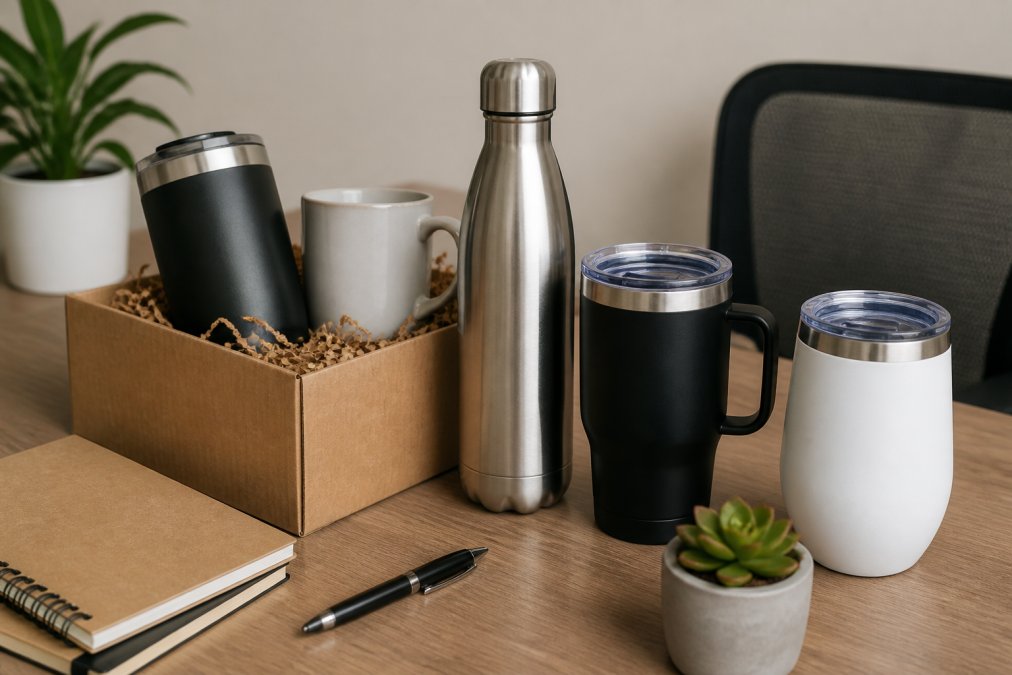
Branded drinkware is reusable, logo-bearing drinkware such as tumblers, mugs, and bottles, given to employees as part of a welcome kit. Material choice is the single biggest factor in whether that item gets used daily or buried in a drawer.
Here's how the main materials compare:
| Material | Best For | Durability | Typical Use |
|---|---|---|---|
| Stainless steel | Field, remote, commuting | High | Water, coffee |
| Ceramic | Office desks | Medium | Coffee, tea |
| Glass | Office, meetings | Low | Cold drinks |
| BPA-free plastic | Events, large groups | Medium | Water |
Stainless Steel and Vacuum-Sealed Options
Stainless steel is the safest default for most welcome kits. It survives drops, fits car cup holders, and keeps drinks hot or cold for hours.
Ceramic, Glass, and BPA-Free Plastic
Ceramic mugs feel premium and work well for office-based teams. Glass looks sharp in meetings but chips easily. BPA-free plastic is the budget-friendly pick for large groups or one-off events.
Step 2: Choose Capacity, Lid Style, and Portability
Capacity and lid style decide whether employees carry the item or leave it at home. Most people use a 12 to 16 ounce tumbler for coffee and a 20 to 24 ounce bottle for water.
- Fits a standard car cup holder
- Lid seals tight and doesn't leak in a bag
- Weight feels balanced when full
- Handle or grip for easy carrying
Step 3: Pick the Best Branded Drinkware for Employees
The best branded drinkware for employees is the piece they reach for every day, not the fanciest one on the shelf. Match the item to the person, the role, and the workplace.
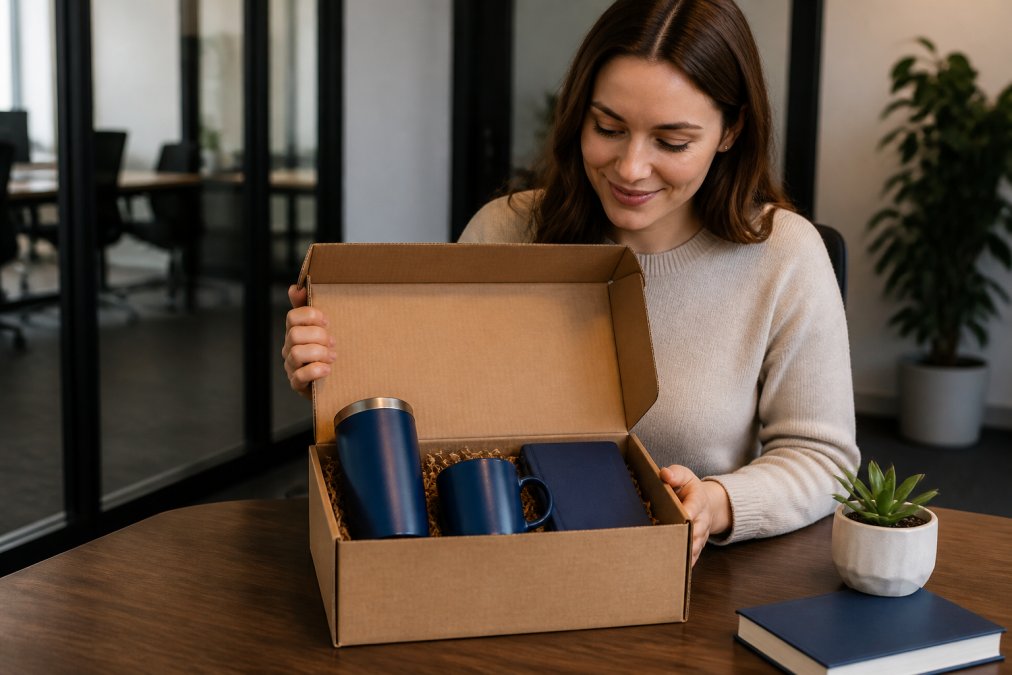
Think about the role before you order:
- Office-based staff: ceramic mug or glass tumbler
- Remote and hybrid staff: insulated stainless steel bottle
- Field and site staff: heavy-duty steel with a sealed lid
- Event and trade show use: BPA-free plastic in bulk
Step 4: Select Eco-Friendly Corporate Drinkware Options
Eco-friendly corporate drinkware options cut waste and signal the values your company stands for. A reusable tumbler or bottle can replace hundreds of single-use cups over its lifetime, and that math is what makes the choice defensible to finance as well as to employees. Pairing these sustainable vessels with high-quality branded coffee options ensures that your welcome kit delivers a complete and thoughtful experience from the very first sip.
What to actually verify
- Recycled content, by percentage. Ask for the post-consumer recycled (PCR) percentage by weight, not a yes/no answer. Recycled stainless steel and recycled PET are the two most common inputs in corporate drinkware. A supplier who cannot state a percentage usually cannot verify one.
- Food-contact safety. BPA-free is the floor, not the ceiling. Confirm the material is food-grade and intended for repeated hot and cold beverage contact. The FDA's food contact substance guidance explains what makes a material safe for food and drink contact, and it is the reference a supplier should be able to speak to.
- Packaging. The drinkware can be recycled and the box can still be landfill. Ask whether the outer packaging is plastic-free, recyclable, or compostable, and whether inserts are paper or foam.
- End-of-life. A steel tumbler is recyclable at end of life; a mixed-material bottle with a bonded plastic base often is not. Single-material construction is easier to recycle and easier to defend.
- Shipping footprint. Consolidating a bulk order to one office address produces far fewer shipping emissions per unit than mailing individual kits to home addresses. That trade-off is real and worth naming in your internal write-up.
The greenwashing traps
Three patterns show up repeatedly in corporate swag sourcing:
- Vague language. "Eco-conscious" and "earth-friendly" mean nothing without a number or a certification behind them. Ask for the specific claim in writing.
- One green feature on a disposable product. A recycled lid on a non-recyclable body is a partial improvement, not a sustainable item. Judge the whole product.
- Sustainability as a sticker. If the eco story is not explained to the employee, it does not land. A short insert card that states the recycled content and the packaging choice turns a claim into a message.
Pair the material with the message
A final trade-off worth naming: the most sustainable drinkware is the one an employee actually keeps and uses for years. Durability and eco-friendliness point in the same direction, a heavier, single-material steel tumbler that survives a decade beats a lightweight "green" item that gets replaced every year.
Step 5: Learn How to Design Branded Office Swag
Knowing how to design branded office swag means getting the logo placement and imprint method right before anything goes to print. Good design looks intentional. Bad design looks like a freebie.
Next, pick an imprint method:
- Screen printing: bold, single-color logos, low cost at volume
- Laser engraving: permanent, premium look on steel
- Full-color print: detailed or multi-color logos
- Debossing: subtle, textured finish on select items
Step 6: Plan Budget, Logistics, and Remote vs. In-Office Delivery
Budget and logistics decide whether your kit arrives on time and on budget, and for distributed teams, logistics is usually the harder problem. Most guides treat shipping as a footnote. In practice, remote delivery is where welcome kits fail.
How drinkware pricing actually works
Unit price is a function of four variables, and they interact:
- Quantity. Per-unit cost drops as volume rises, but most suppliers set a minimum order quantity (MOQ) per design. Below the MOQ, you either pay a small-order surcharge or accept a stock design.
- Decoration method. Screen printing is the cheapest per unit at volume but adds a setup charge per color. Laser engraving carries a higher per-unit cost but no color setup and no ink to fade. Full-color print is the most expensive per unit and usually requires a higher MOQ.
- Number of colors and print locations. Each additional color or location adds a setup charge and, often, a per-unit charge. A one-color, one-location logo is the lowest-cost configuration that still looks intentional.
- Packaging and inserts. Custom boxes, tissue, and printed cards are priced separately and can rival the drinkware cost per kit if you over-design them.
In-office kits: bulk to one address
For a single office, kits ship in bulk to one receiving address. This is the cheapest and simplest model. Costs to plan for:
- Freight or parcel shipping on the full order
- Receiving and internal distribution (someone has to assemble and hand out the kits)
- Storage if kits arrive before the start date
Remote kits: individual home delivery
Remote kits ship to individual home addresses, and that changes the economics and the risk profile:
- Per-unit shipping cost rises sharply. You lose bulk freight rates and pay individual parcel rates, often several times the per-unit bulk cost.
- Address accuracy becomes the bottleneck. Every kit needs a confirmed, current home address before the order closes. Address changes after production are the most common cause of late welcome kits.
- Delivery timing is unpredictable. A kit that ships to an office arrives on a known date. A kit shipped to a home can sit on a porch, get misdelivered, or arrive after the employee's first day.
- Returns and reships are expensive. A failed delivery usually means a second shipment at full parcel cost, plus a replacement item if the original is lost.
A practical budgeting sequence
- Set the per-employee kit budget first, then work backward to the drinkware unit cost.
- Get quotes at your real quantity, not a round number, since MOQ tiers shift the price.
- Add decoration setup as a one-time cost, separate from per-unit cost.
- Add packaging and inserts as a per-kit cost.
- Add shipping as two separate lines: bulk-to-office and per-unit-to-home, because they are not the same number.
- Hold back a contingency for reships and address failures.
Step 7: Test Durability, Safety Standards, and Inclusive Design
Durability and safety decide whether your drinkware holds up over years of use. Test before you commit to a large order.
Run a simple durability check on samples:
- Drop test from desk height
- Dishwasher cycle test
- Leak test on the lid
- Check for cracks or fading after washing
Frequently Asked Questions
What are the best types of drinkware for employee welcome kits?
The best branded drinkware depends on where employees work. For office-based teams, 15 oz ceramic mugs and 16 oz vacuum-sealed stainless steel tumblers work well. Remote employees benefit from 20 oz insulated tumblers with secure lids. Consider offering two options so new hires can pick what fits their routine. Materials matter too: stainless steel keeps drinks hot or cold for hours, while ceramic suits coffee drinkers who stay at a desk. Eco-friendly materials like recycled steel add a sustainability message that many employees appreciate.
Are stainless steel tumblers better than ceramic mugs for welcome kits?
Stainless steel tumblers outperform ceramic mugs in portability and temperature retention. A vacuum-sealed tumbler keeps drinks hot for 6 to 12 hours, while ceramic mugs lose heat within 30 minutes. Stainless steel also survives drops and commutes better. Ceramic mugs still make sense for office-only staff who want a classic coffee experience. If your team splits between remote and in-office work, stainless steel is the safer default for branded drinkware in welcome kits.
How does branded drinkware impact new employee engagement?
Quality branded drinkware signals that a company invests in the new hire experience. When a tumbler or mug holds up over months of daily use, it reinforces company culture and brand identity every time the employee reaches for it. Cheap items that break or leak do the opposite. HR managers report that well-chosen employee welcome kits help new hires feel connected from day one, supporting retention and making the onboarding essentials feel intentional rather than like an afterthought.
How do I design branded office swag that employees actually use?
Start with restraint. A single logo placement in one or two colors reads more professional than a wrap-around design. Choose imprint methods that match the surface: laser engraving for stainless steel, screen printing for ceramic, and UV printing for curved or colored surfaces. Keep the slogan short and skip clutter. Test the design on a sample before placing a bulk order. The goal is drinkware that looks like something an employee would buy, not a giveaway item that ends up in a drawer.
Building a welcome kit that employees actually keep takes more than picking a logo color. It takes the right material, capacity, and design for each role. BicClic.com has supplied custom imprinted pens and promotional items across North America for over 14 years, including genuine Bic products, stationery, and drinkware. Our team helps you match the right item to the right team and get it delivered on time. Get started with BicClic.com and build welcome kits your new hires hold onto.