 blog
8 Promotional Items That Build Trust With Clients
Last Updated: November 22, 2026
Quick Summary
Promotional items build trust by putting a brand into someone's daily routine, where repeated exposure turns recognition into familiarity and familiarity into credibility. Quality is the trust signal, so a pen that skips or a bottle that leaks teaches recipients that the brand cuts corners. The eight items that build trust include genuine brand pens, insulated drinkware, reusable tote bags, notebooks and stationery, technology accessories, branded apparel, event giveaways, and thoughtful client gifts.
- Pens win on frequency, getting picked up dozens of times a day for cheap repeat exposure.
- Score every candidate item on durability, usefulness, audience fit, perceived value, and cost per retained use.
- Request a sample and check the imprint and finish before committing to a large run.
- Small budgets should prioritize pens, notebooks, and totes for the most impressions per dollar.
- Track retention rate at 30, 90, and 180 days as the closest proxy for repeat exposure.
Table of Contents
- Why Promotional Items Build Brand Trust
- The 8 Promotional Items That Build Trust
- 1. Genuine Brand Pens: The Everyday Trust Signal
- 2. Insulated Drinkware: Quality You Can Feel
- 3. Reusable Tote Bags: Visibility That Travels
- 4. Notebooks and Stationery: Credibility in Hand
- 5. Technology Accessories: Utility That Earns Desk Space
- 6. Branded Apparel: Social Proof People Wear
- 7. Event Giveaways: Trust Built at the Booth
- 8. Thoughtful Client Gifts: Relationship Building Beyond the Sale
- How to Choose the Best Promotional Items to Give Away
- Promotional Items for Small Business Marketing on a Tight Budget
- Top Promotional Products for Clients and Prospects
- Promotional Products for Brand Awareness: Measuring What Works
- Ordering Custom Imprinted Items for Your Next Event
- Frequently Asked Questions
Why Promotional Items Build Brand Trust
Promotional items build trust because they put a brand into someone's daily routine, where repeated exposure turns recognition into familiarity and familiarity into credibility.
The mechanism is simple. A pen that writes well sits on a desk for months, and every reach for it is another quiet brand impression.
The catch most buyers miss: trust only accrues when the item is good.
The 8 Promotional Items That Build Trust

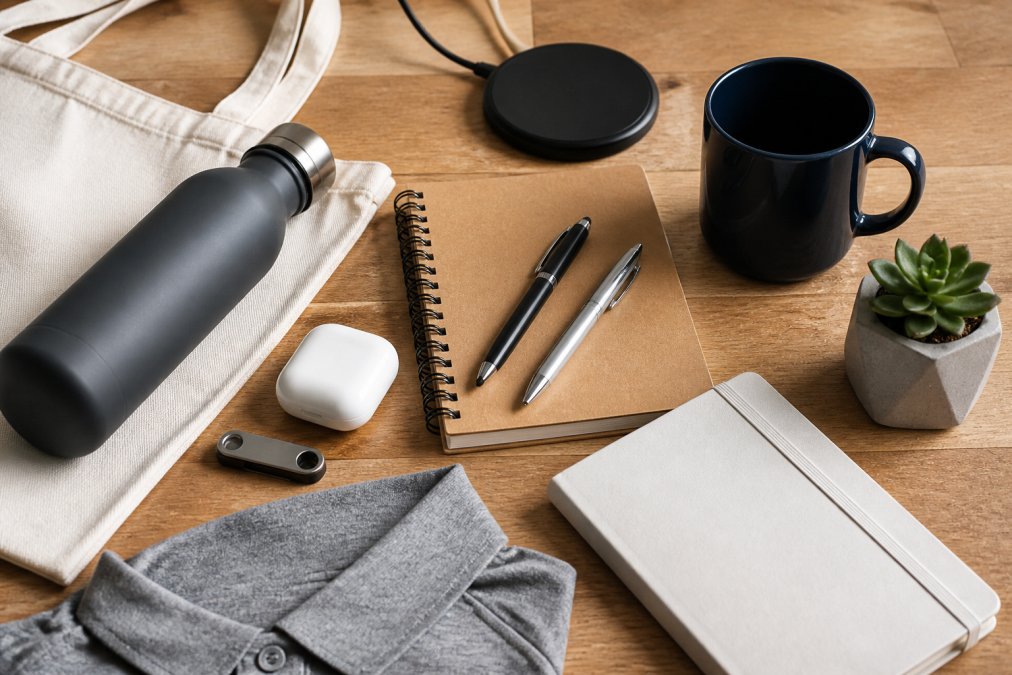
These eight items earn their place because each ties to a specific trust mechanism, not just a logo impression. Here is the summary before the detail:
| Item | Trust Mechanism | Best For |
|---|---|---|
| Genuine brand pens | Daily repeat exposure | Broad audiences, events |
| Insulated drinkware | Perceived quality | Clients, employees |
| Reusable tote bags | Mobile brand visibility | Conferences, retail |
| Notebooks and stationery | Professional credibility | Client appreciation |
| Technology accessories | Desk-space utility | B2B prospects |
| Branded apparel | Social proof | Teams, loyal customers |
| Event giveaways | First-contact trust | Trade shows |
| Thoughtful client gifts | Relationship depth | Key accounts |
1. Genuine Brand Pens: The Everyday Trust Signal
Pens win on frequency. A quality pen gets picked up dozens of times a day, making it the cheapest form of repeat exposure available to most marketing teams. The mistake we see most often is buying generics that skip and smear; recipients notice, and the brand pays for it.
Best for: broad distribution, trade shows, front-desk handouts. Skip if: you need a high-perceived-value gift for a key account.
2. Insulated Drinkware: Quality You Can Feel
Drinkware carries trust through perceived value and durability. A well-made insulated bottle or tumbler feels substantial, keeps drinks cold through a workday, and stays on a desk for years. For guidance on matching drinkware to employee programs, see our breakdown of how to choose branded drinkware for employee welcome kits.
Best for: client gifts, employee recognition. Skip if: your budget per unit is very low.
3. Reusable Tote Bags: Visibility That Travels
Tote bags turn recipients into walking billboards at grocery stores, conferences, and gyms, extending brand visibility well beyond the office.
Best for: event audiences, retail. Skip if: your audience rarely carries bags.
4. Notebooks and Stationery: Credibility in Hand
Stationery signals professionalism. A well-bound notebook with a clean logo treatment reads as considered and credible, which matters in client-facing industries like law, consulting, and finance. Our guide to branded stationery for client appreciation covers paper weight, binding, and logo placement in more depth.
Best for: professional services, client appreciation. Skip if: your audience has gone fully digital.
5. Technology Accessories: Utility That Earns Desk Space
Tech accessories such as cable organizers, phone stands, and mousepads earn trust through pure usefulness. Desk space is scarce, so an item that survives the cull has passed a real test. This category suits B2B prospects who spend their day at a computer.
Best for: B2B outreach. Skip if: you cannot verify build quality.
6. Branded Apparel: Social Proof People Wear
Best for: teams, brand advocates. Skip if: sizing logistics are unmanageable.
7. Event Giveaways: Trust Built at the Booth
Event giveaways earn trust by starting a conversation. A useful item at a trade show booth gives attendees a reason to stop, the first step in any relationship. Match the item to the audience: pens and totes for general crowds, drinkware for qualified leads.
Best for: trade shows, conferences. Skip if: the item is generic filler.
8. Thoughtful Client Gifts: Relationship Building Beyond the Sale
Client gifts build trust when they feel considered rather than promotional. A premium notebook or quality tumbler sent after a project close signals that the relationship matters.
Best for: key accounts, renewals. Skip if: the gift feels transactional.
How to Choose the Best Promotional Items to Give Away
Choosing the best promotional items to give away comes down to a repeatable framework rather than a gut feeling. Score every candidate on five criteria, weight them for your situation, and let the lowest scores eliminate items before you request samples. The framework matters more than any single product, because the right item for a trade show is rarely the right item for a key account renewal.
The five selection criteria
- Durability: will it survive daily use for a year? Check material, construction, and wash or wear instructions. A thin non-woven tote and a heavy canvas tote score very differently.
- Usefulness: does your audience already use this item type? Ask ten customers what is on their desk right now. If the item is not already in their routine, a logo will not put it there.
- Audience fit: does it match their profession, setting, and seniority? A cable organizer suits a desk-bound B2B prospect; a premium notebook suits a client-facing professional; a cap suits a field team.
Weighting the criteria by context
| Context | Highest-weighted criteria | Lower priority |
|---|---|---|
| Trade show, broad audience | Usefulness, cost per retained use | Perceived value |
| Client appreciation | Perceived value, durability | Cost per retained use |
| Employee program | Durability, audience fit | Perceived value |
| Prospect outreach | Audience fit, usefulness | Perceived value |
Budget tiers and quantities
Match the item to the budget band and the number of recipients you can actually reach. Pricing depends on quantity, timing, and delivery, so request a quote from BicClic.com for current prices on any item. Order in the quantity you can distribute within one quarter, and keep a reserve for follow-ups.
Personalization and consent
Personalization raises perceived value, but only when it is accurate and welcome. Confirm names, spellings, titles, and shipping details before ordering, and give recipients a way to decline future gifts. Collecting personal data for a gift creates an obligation to protect it, so limit what you collect to what the gift requires.
Sustainability, sourcing, and accessibility
These considerations increasingly decide whether a gift reads as credible. Ask suppliers about material composition, recycled content, and end-of-life options, and prefer genuinely reusable items over single-use novelties. On accessibility, choose clear, high-contrast imprints, avoid tiny text, and consider whether the item works for people with limited grip or vision. The point is to avoid a gift that contradicts the trust message you are trying to send.
Quality control before you commit
Request a sample and check the imprint and the finish before committing to a large run. Our article on how to ensure promotional product quality walks through the checks worth doing before you sign off.
Watch out: skipping the sample stage is the most common and most expensive mistake in this category.
Promotional Items for Small Business Marketing on a Tight Budget
Small budgets still buy trust, provided the spend concentrates on fewer, better items. One quality pen per prospect beats three forgettable trinkets, because the item people keep is the item that works.
Prioritize pens, notebooks, and totes, which deliver the most impressions per dollar. For a curated list of affordable options, see our roundup of the best promotional items for small business marketing.
Top Promotional Products for Clients and Prospects
The top promotional products for clients and prospects split by relationship stage. Prospects need low-cost, high-frequency items that keep the brand present. Clients need higher-perceived-value gifts that acknowledge the relationship.
- Prospects: pens, tech accessories, event giveaways
- Clients: drinkware, notebooks, thoughtful gifts
- Both: apparel for advocates, totes for visibility
Match the item to the stage and the trust mechanism follows.
Promotional Products for Brand Awareness: Measuring What Works
Promotional products for brand awareness are measurable if you set the measurement up before distribution. Promotional items are branded merchandise given away to keep a company visible and top of mind with a target audience. The gap in most programs is not that measurement is impossible; it is that nobody defines the outcome before the boxes arrive.
Metrics worth tracking
- Retention rate: the share of recipients still using the item at 30, 90, and 180 days. A short follow-up survey or a redemption prompt on a unique URL can capture this. Retention is the closest practical proxy for repeat exposure.
- Aided and unaided recall: ask a sample of recipients and a matched non-recipient sample to name brands in your category. The difference between the two groups is your lift, not the raw recall number.
- Redemption and response rate: unique codes, QR codes, or dedicated landing pages tied to a specific item. Compare redemption across item types rather than against an absolute target.
How to run it without an analytics team
A simple spreadsheet and a consistent process will tell you which items earn repeat exposure and which end up in drawers. Assign each item a code or URL, log distribution date and quantity, and schedule the 30/90/180-day check when you place the order. Keep the survey to three questions so response rates stay usable.
Where measurement breaks down
Attribution is the honest limitation. A recipient who recalls your brand may have seen a billboard, a sales call, or a conference talk in the same window, and promotional items rarely carry enough volume to isolate cleanly.
Watch out: measuring after the fact is nearly impossible, because you cannot reconstruct who received which item or what their baseline recall was. Build the tracking into the order and distribution plan, not the post-mortem.
Ordering Custom Imprinted Items for Your Next Event
Order custom imprinted items early and build in a buffer before the event date. Confirm the production schedule with BicClic.com before you finalize the booth plan.
Lock the design before production begins, and ask about minimum order quantities and revision policies up front.
Trust in promotional items is earned one useful object at a time.
Frequently Asked Questions
How can promotional items help build customer trust?
Trust comes from repeated, positive exposure. A useful item like a genuine branded pen or insulated bottle sits on a desk or in a bag and gets handled daily, so your logo becomes familiar rather than forgettable. Pair that visibility with real product quality, and recipients associate your brand with reliability. The key is choosing items people actually use, not items that end up in a drawer. Durability and usefulness matter more than a clever slogan.
What makes a branded giveaway feel useful rather than promotional?
Usefulness is about fit, not novelty. A water bottle, notebook, or phone accessory earns its place because it solves a daily problem. Items that feel promotional usually have oversized logos, flimsy construction, or no practical purpose. Choose products your target audience already buys for themselves, keep branding tasteful, and let quality carry the message. If the item would be worth keeping without your logo on it, it will get used with your logo on it.
Which promotional items are best for clients and prospects?
For prospects, focus on high-visibility items for events and first meetings: quality pens, drinkware, and tote bags. For existing clients, move toward thoughtful gifts that reflect the relationship, such as premium stationery or branded apparel. Match the item to the relationship stage and the recipient's daily routine. A sales director who travels will use a durable notebook; a hotel manager may value drinkware for the front desk. Audience fit decides more than price.
How do you choose promotional products for a small business?
Start with your goal: booth traffic, client retention, or brand awareness. Then set a per-item budget that leaves room for quality, since cheap items can hurt a brand more than help it. Order small quantities first to test how recipients respond, and prioritize items with long lifespans like pens, bottles, and bags. Personalization and on-time delivery matter too, so confirm production timelines before committing to an event date.