 Listicle
Which Promotional Products Work Best for Restaurants?
Last Updated: October 28, 2026
Quick Summary
The best promotional products for restaurants are items guests use during or after the meal, such as coasters, placemats, drinkware, and reusable bags. These keep the brand visible longer than pens or magnets. Choose items that match your dining room's level of polish and the moments guests actually spend with your brand.
- Coasters are the cheapest per-impression table item, with unit costs of $0.25-$0.75.
- Custom pint glasses often go home with guests, extending visibility beyond the visit.
- Reusable tote bags suit takeout and delivery, since guests can reuse them for groceries.
- Start with a test budget of a few hundred dollars per item, then scale the winners.
- Track results with QR codes, offer codes on giveaways, and campaign-specific landing pages.
Table of Contents
- Why Restaurant Branding Needs Products Guests Actually Keep
- Restaurant Promotional Items That Work Best at the Table
- Branded Merchandise for Restaurants: Apparel and Staff Wear
- Restaurant Giveaway Ideas That Customers Keep
- Custom Promotional Products for Restaurants by Service Model
- Budgeting, Minimum Orders, and Measuring Return
- Frequently Asked Questions
Why Restaurant Branding Needs Products Guests Actually Keep
Most promotional products end up in a drawer within a week. For restaurant owners, that means a logo printed on a pen or a magnet gets little attention once a guest leaves the building. The better question is which promotional products a guest will use again, and that is where a restaurant can gain real brand visibility. This guide walks through promotional product categories, how to choose among them, and how to plan an order.
Promotional products are branded items given away or sold to build awareness and goodwill. Restaurants rarely need a large catalog of them.
Watch out: A branded item that looks cheap can work against the restaurant's image. Choose items that match the dining room's level of polish.
Restaurant Promotional Items That Work Best at the Table
Items that sit on the table during a meal get the most repeated exposure. Guests see them while they eat, wait for the check, and sometimes take them home. Items that already belong in the dining experience may feel natural rather than promotional.
Coasters, Placemats, and Menus
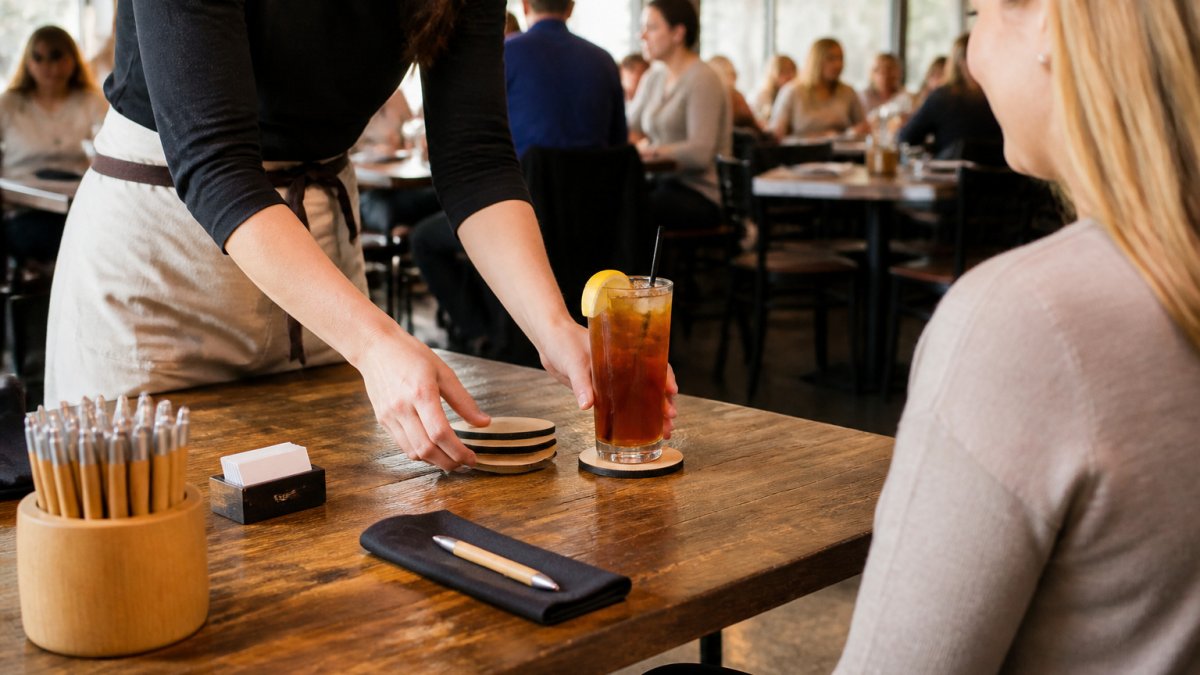
Custom coasters are one of the simplest table items for bars and restaurants. A coaster can display the logo while guests drink, which places the brand in view during every round. Branded placemats and menus follow the same logic: they are seen during the meal itself, not after it.
Menus and table tents are useful for promoting specials, events, or a loyalty program. Keep the design simple so the message reads at a glance across the table.
Drinkware and Bar Accessories
Drinkware combines beverage service with a take-home opportunity. Custom pint glasses are often described as a souvenir guests keep, which can extend brand visibility well beyond the visit. Read how to choose durable branded drinkware. Reusable straws are another option for restaurants and bars that want a reusable branded item for beverage service. They suit places where guests appreciate sustainability, though you should confirm material and customization details with the supplier before ordering.
Branded Merchandise for Restaurants: Apparel and Staff Wear
Staff apparel is one of the most visible branding tools a restaurant has. Front-of-house teams who wear coordinated shirts, aprons, or vests create a consistent appearance that guests notice. It also signals that the staff represents the brand.
Apparel decisions should consider comfort, durability under daily washing, and the uniform standards already in place. A coordinated look often matters more than any single garment. Retail-style branded shirts can also serve as merchandise guests buy, but that is a separate decision from staff wear.
Restaurant Giveaway Ideas That Customers Keep
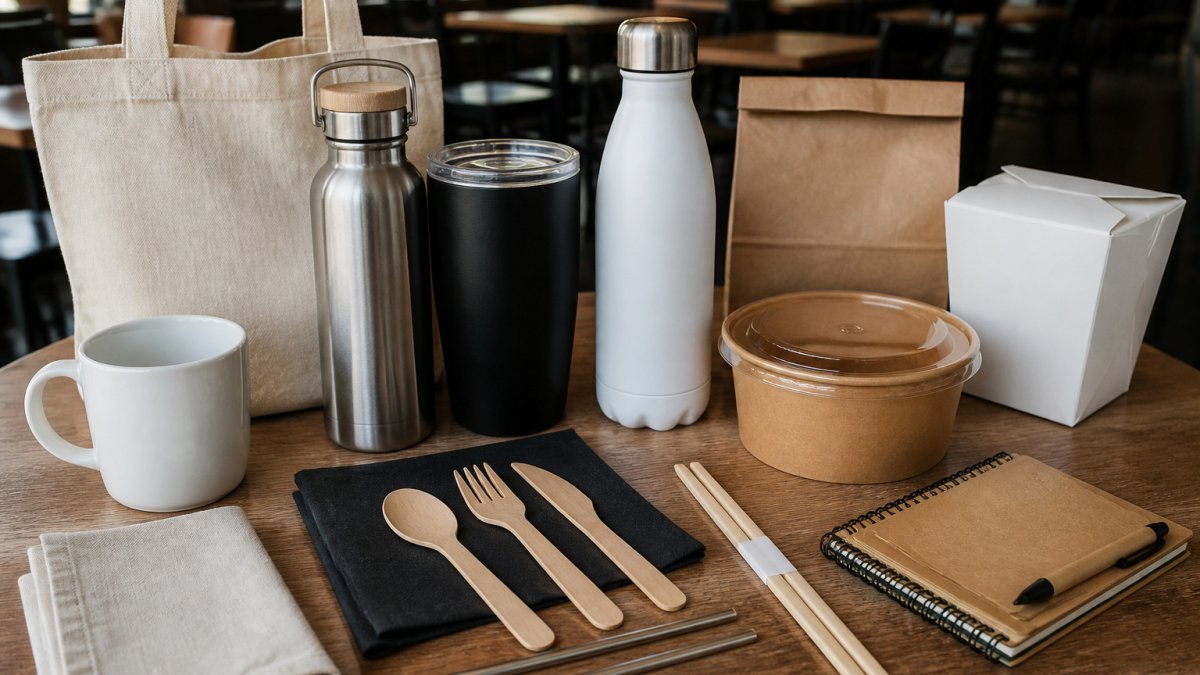
Giveaways work best when the item solves a small problem. Browse more promotional items for small business marketing. Reusable bags suit restaurants that offer takeout, since guests can reuse the bag for groceries or other purchases. A reusable bag keeps the brand visible after the transaction ends, which is the main advantage over a disposable promotional item.
Other giveaway options include branded mints, candies, or drinkware sold or offered during events. Keep in mind that food-related giveaways may need to meet local food safety requirements, so check with the supplier and your health department before ordering consumables.
Custom Promotional Products for Restaurants by Service Model
The right promotional product depends on how guests move through your business. A quick-service counter, a full-service dining room, a cafe, a food truck, and a delivery-first kitchen each have different touchpoints, and the item that works in one can be wasted in another. The table below maps service models to best-fit items and the reason each works.
| Service Model | Best-Fit Items | Why It Works | Watch-Out |
|---|---|---|---|
| Quick-service / fast casual | Branded cups, tray liners, window decals, reusable bags | High volume and short dwell time; cups and bags travel with the guest | Cup lids and straws must meet food-contact rules; confirm with supplier |
| Full-service dining | Coasters, placemats, menus, table tents | Visible throughout the meal and at check presentation | Paper items need reordering discipline; keep a par level |
| Cafe / coffee shop | Reusable cups, sleeves, loyalty cards, stickers | Guests carry cups and sleeves into the day; stickers appeal to regulars | Sleeves must be food-safe and fit standard cup sizes |
| Bar / lounge | Coasters, custom pint glasses, bottle openers | Used with every round; pint glasses often go home | Glass breakage raises replacement cost; budget for shrink |
| Food truck | Stickers, magnets, branded napkins, QR-code signage | Small, portable items suit walk-up service and social sharing | Magnets only work if guests have a metal surface; stickers travel further |
| Delivery-first | Branded bags, box seals, insert cards, QR codes on packaging | The item is the only physical brand touchpoint after the order leaves | Packaging must survive transit; test seals and bag handles |
| Staff-facing operations | Apparel, aprons, vests, name tags | Consistent team appearance signals brand standards | Comfort and wash durability matter more than logo size |
Quick-service and fast casual. Volume is the defining constraint. Branded cups and tray liners reach every guest, but the per-unit cost has to stay low enough to absorb into food cost. Reusable bags work well here because they bridge the counter and the guest's home. Confirm that any cup, lid, or straw you print on is rated for food contact and that the ink used is appropriate for the material.
Full-service dining. Table items earn repeated exposure because guests sit with them for 45 to 90 minutes. Coasters and placemats are the workhorses; menus and table tents carry promotions. The operational risk is running out, so set a par level and reorder before the busy season rather than during it.
Cafes and coffee shops. Regulars are the audience. A reusable cup or a branded sleeve travels with the guest and gets seen by coworkers and passersby. Loyalty cards and stickers are low-cost ways to reward repeat visits, and a QR code on the card can route to a sign-up page.
Bars and lounges. Coasters are the cheapest per-impression item in the building. Custom pint glasses cost more per unit but often leave with the guest, which extends visibility. Budget for breakage and shrinkage; glass does not survive every night.
Food trucks. Portability and shareability matter more than table presence. Stickers and magnets are small, cheap, and often end up on laptops, coolers, and refrigerators. QR-code signage on the truck can drive follows and orders. Napkins and packaging inserts are useful but only if they survive the walk-up window.
Delivery-first concepts. Once the bag leaves the kitchen, the packaging is the brand. Branded bags, box seals, and insert cards are the only physical touchpoints, so they need to survive transit and look intentional. A QR code on the insert card can drive a reorder or a review request.
Staff-facing operations. Apparel and aprons are branding tools aimed at guests, not giveaways. Prioritize comfort, wash durability, and a consistent look over a large logo. Name tags and vests help guests identify staff in a busy room.
Match your choices to where guests actually spend time with the brand.
Budgeting, Minimum Orders, and Measuring Return
Most restaurant operators do not need a promotional-products line item in the double-digit thousands. A common pattern is to start with a test budget of a few hundred dollars per item, confirm the item gets used, then scale the winners. The table below shows typical US price bands and minimum order quantities (MOQs) for the categories covered in this guide. Treat these as planning ranges, not quotes, screen-print and embroidery setup fees, rush production, and multi-color logos all move the unit cost. Refining these selections requires a strategic approach to choosing promotional products that align with the specific logistics and audience expectations of your upcoming events.
| Product | Typical unit cost (USD) | Typical MOQ | Notes |
|---|---|---|---|
| Custom coasters (paper or pulpboard) | $0.25-$0.75 | 250-500 | Cheapest per-impression table item; best for bars and high-turn tables |
| Branded placemats (paper) | $0.40-$1.00 | 500-1,000 | Often bundled with menu printing |
| Custom pint glasses (glass) | $2.50-$5.00 | 72-144 | Higher unit cost, but guests take them home; confirm food-contact-safe inks |
| Reusable tote bags (non-woven) | $1.50-$3.50 | 100-250 | Strong fit for takeout and delivery-first concepts |
| Staff T-shirts (screen-printed) | $6-$12 | 24-48 | Setup fee of $25-$75 per color is common |
| Aprons (embroidered) | $12-$25 | 12-24 | Embroidery digitizing fee of $25-$50 one-time |
| Branded mints or wrapped candies | $0.10-$0.40 | 500-1,000 | Check FDA food-labeling and state health-department rules before ordering |
Minimum order quantities. MOQs are driven by the decoration method, not the blank product. Screen printing needs a screen per color, so a four-color logo on a tote can push the MOQ to 250 units even if the blank is available in smaller runs. Embroidery requires a digitized file and a hoop change per location, which is why embroidered aprons often start at a dozen. If you want a small test run, ask the supplier about digital printing or heat-transfer decoration, which usually carries lower MOQs at a higher per-unit cost.
Setup and hidden fees. Budget for one-time charges: screen or embroidery setup, digitizing, and proof fees. Ask whether the quote includes shipping to a single address or per-location drop shipping, since multi-unit restaurants often pay more to split a shipment. Sales tax treatment varies by state; promotional items are generally taxable, but confirm with your accountant.
Measuring return. The practical way to connect merchandise to visits is to make the item trackable:
- QR codes on table items. A QR code on a coaster or table tent can route to a menu, a loyalty sign-up, or a limited-time offer. Use a UTM-tagged URL so your analytics platform attributes scans to the campaign.
- Offer codes on giveaways. Print a unique code on tote bags or pint glasses that can be redeemed for a dessert, a drink, or a discount. Count redemptions at the POS.
- Campaign-specific landing pages. A short URL such as yourdomain.com/coaster lets you compare traffic from each product without guessing.
- Staff observation logs. For table items, a simple weekly count of how often guests ask about or take the item is a low-tech but reliable signal.
A simple test-and-scale rule.
Frequently Asked Questions
What are branded promotional items?
Branded promotional items are products customized with a company's logo, name, or message and given away or used in daily operations. BicClic.com specializes in custom imprinted pens and promotional office items, including genuine Bic pens, lighters, stationery, and drinkware. Pricing depends on quantity, dates, and delivery; visit BicClic.com for current prices or a quote.
Which promotional products work best for restaurants?
Choose promotional products that fit your service model and the way you want to promote your business. BicClic.com specializes in custom imprinted pens and promotional office items, including genuine Bic pens, lighters, stationery, and drinkware.
What restaurant giveaways are customers most likely to keep?
BicClic.com offers custom imprinted pens and promotional office items, including genuine Bic pens, lighters, stationery, and drinkware. Pricing and order details depend on the product and order; visit BicClic.com for current information.
What should restaurants consider when choosing promotional products?
Consider how a promotional product fits your goals and what information you need before ordering. For current product and order details, visit BicClic.com.
Ready to plan your first run? Request a quote from BicClic.com for coasters, drinkware, reusable bags, or staff apparel, and tell us your quantities and timeline so we can recommend a practical starting order.